
Most homebuyers spend more time researching a refrigerator than comparing mortgage rates. That single oversight can cost tens of thousands of dollars over the life of a loan. The good news: shopping for a mortgage rate is not complicated. It just requires a deliberate process.
Done correctly, rate shopping protects your credit score, surfaces lenders competing for your business, and gives you real leverage at the closing table. This guide walks you through exactly how to shop for mortgage rates in Virginia — from Richmond and Chesterfield to Fredericksburg, Williamsburg, Virginia Beach, and beyond — using a structured, step-by-step approach that works whether you are buying your first home, refinancing an existing loan, or exploring a HELOC.
You will learn how to prepare your financial profile before any lender ever sees it, how to request quotes that are truly apples-to-apples, how to read a Loan Estimate without getting lost in the fine print, and how to use a mortgage broker’s access to hundreds of lenders as a rate-shopping advantage.
One important note before you begin: you do not have to accept a hard credit inquiry just to explore your options. A soft-pull pre-qualification — sometimes called a NoTouch Credit solution — lets you see realistic rate ranges without any impact to your credit score. That matters enormously when you are reaching out to multiple lenders at once.
By the end of this guide, you will have a repeatable, confidence-building framework for finding a competitive mortgage rate and the knowledge to recognize a genuinely good offer when you see one.
Step 1: Understand What Actually Moves Your Rate
Before you contact a single lender, you need to understand the five core factors that determine the rate you will be offered. Walking in without this knowledge is like negotiating a car price without knowing the invoice cost.
Credit Score: Your score is the single most influential factor. Lenders use specific thresholds to price risk. Moving from one tier to the next can meaningfully change your monthly payment and total interest paid over the life of the loan.
Loan-to-Value Ratio (LTV): LTV is your loan amount divided by the appraised property value. A 20% down payment brings your LTV to 80%, which eliminates private mortgage insurance (PMI) on conventional loans. Cash-out refinances up to 90% LTV are available through certain programs, though higher LTV typically means a higher rate.
Loan Type: Conventional, FHA, VA, USDA, Jumbo, Non-QM, and DSCR loans each carry different rate characteristics and eligibility requirements.
Loan Term: A 15-year fixed rate is always lower than a 30-year fixed rate. The tradeoff is a higher monthly payment in exchange for less total interest paid.
Property Type: A primary residence gets the best pricing. Investment properties and second homes carry rate adjustments because they represent higher default risk to lenders.
The table below shows how these loan types compare across key dimensions:
Loan Type Comparison Table
Conventional: Minimum credit score typically 620 (many lenders prefer 640+), LTV up to 97% with PMI, best pricing for scores 740+, conforming loan limit $806,500 (2025 baseline — verify current limit at fhfa.gov).
FHA: Minimum credit score 500 (with 10% down) or 580 (with 3.5% down), LTV up to 96.5%, includes mandatory mortgage insurance premium (MIP), loan limits vary by county — check current figures at HUD.gov.
VA: No minimum score set by VA (lenders typically require 580–620), no loan limit for eligible veterans with full entitlement, no PMI, competitive rates — details at VA.gov.
USDA: Minimum credit score typically 640, rural areas only, no down payment required, income limits apply.
Jumbo: Loan amounts above conforming limit, minimum credit score typically 700–720, larger reserves required, stricter underwriting.
Non-QM / Bank Statement: Credit score minimums vary by lender, designed for self-employed borrowers with non-traditional income documentation, higher rates reflect additional risk.
DSCR (Investor): No personal income verification, qualification based on property cash flow, minimum score typically 640–680, rates vary based on DSCR ratio and LTV.
Why does the same borrower get different rates from different lenders? Because each lender sets its own overlays (internal credit requirements stricter than the loan program minimum), its own margin structure, and its own secondary market pricing. Two lenders offering the same loan type can price the same borrower differently by a quarter point or more. This is precisely why shopping multiple sources matters.
Tip: Before you contact a single lender, know your approximate credit score tier, your estimated down payment percentage, and which loan type you likely qualify for. This is your baseline — and it determines which conversations are worth having.
Step 2: Pull Your Credit Profile Without Triggering Hard Inquiries
Here is something most lenders will not volunteer: you do not have to let them run your credit just to get a rate discussion started. Understanding the difference between a soft pull and a hard pull is one of the most valuable pieces of knowledge a borrower can have.
Soft pull: No impact to your credit score. You can authorize this type of inquiry yourself or allow a lender to use it for pre-qualification purposes. It gives you — and the lender — a reliable picture of your credit profile without any scoring consequences.
Hard pull: Triggered when you formally apply for credit. It can temporarily lower your score by a few points and remains on your credit report for two years (though its scoring impact fades after 12 months).
The good news for serious rate shoppers: FICO scoring models treat multiple mortgage-related hard inquiries within a 14 to 45 day window as a single inquiry. This means you can apply to several lenders within that window and your score is affected only once. You can verify this directly at myFICO.com. The CFPB also addresses this at consumerfinance.gov.
Even better: The Mortgage Ally’s NoTouch Credit solution uses Vantage Score 4.0 to run a soft-pull pre-qualification. You get a realistic rate range and loan program assessment with zero credit impact — ideal for the early exploration phase when you are still comparing options and have not committed to a specific lender or timeline.
To check your own credit before anyone else does, visit AnnualCreditReport.com. This is the only federally authorized source for free credit reports from all three bureaus — Equifax, Experian, and TransUnion.
When reviewing your reports, look for four specific issues:
1. Errors or inaccuracies — disputed accounts, incorrect balances, or accounts that do not belong to you. These can be disputed directly with the bureaus.
2. Collections or derogatory marks — unpaid collections can disqualify you from certain loan programs or push you into a higher rate tier.
3. High utilization — credit card balances above 30% of your limit can suppress your score. Paying balances down before applying can produce a meaningful score improvement within 30 to 60 days.
4. Thin file — fewer than three open tradelines can make it harder for lenders to assess your risk profile, which may limit your loan program options.
Tip: If your score is below 620, address it before applying. Even a 20-point improvement can move you from one pricing tier to the next, reducing your rate and saving real money every month. Credit restoration strategies are worth exploring before you start the formal application process.
Step 3: Gather the Documents Lenders Will Request
Nothing slows down a mortgage quote — or introduces unwanted rate adjustments — like an incomplete file. Lenders who receive complete documentation upfront can price your loan more accurately. Those who receive partial information often build in a cushion to account for the unknowns, and that cushion comes out of your rate.
The documents you need depend on your borrower profile. Here is a clean checklist organized by type:
W-2 Employees (Traditional Income Documentation):
1. Two years of W-2 statements from all employers
2. Thirty days of recent pay stubs
3. Two months of bank statements (all pages, all accounts)
4. Two years of federal tax returns (1040s, all schedules)
5. Government-issued photo ID
6. Current mortgage statement if refinancing
7. Homeowners insurance declarations page if refinancing
Self-Employed / Bank Statement Borrowers:
1. Twelve to twenty-four months of personal or business bank statements (lender dependent)
2. CPA letter confirming self-employment status and business ownership percentage
3. Profit and loss statement (year-to-date, prepared by CPA or accountant)
4. Business license or articles of incorporation
5. Government-issued photo ID
Bank statement loans exist specifically because traditional income documentation — tax returns and W-2s — often understates what a self-employed borrower actually earns after write-offs. The bank statement program uses actual deposits to calculate qualifying income, which is frequently a more accurate picture of real cash flow.
Real Estate Investors (DSCR Loans):
1. Signed lease agreement for the subject property, or a market rent analysis from a licensed appraiser
2. Entity documents if purchasing or refinancing under an LLC (operating agreement, articles of organization)
3. Government-issued photo ID
4. Two months of bank statements to verify reserves
DSCR stands for Debt Service Coverage Ratio. Lenders calculate it by dividing the property’s gross monthly rent by the monthly principal, interest, taxes, insurance, and HOA payment. A DSCR of 1.0 means the rent exactly covers the payment. Most lenders require a DSCR of 1.0 to 1.25 or higher. No personal income verification is required — the property’s cash flow does the qualifying.
Tip: Scan and organize your documents before reaching out to any lender. A complete, organized digital file signals to underwriters that you are a prepared borrower — and prepared borrowers move through the pipeline faster with fewer surprises.
Step 4: Request Quotes the Right Way — And Compare Them Correctly
This is where most borrowers make their biggest mistake. They compare interest rates without comparing the full cost of the loan. A lower rate with higher fees can cost more over your holding period than a slightly higher rate with minimal fees. The only way to know is to do the math.
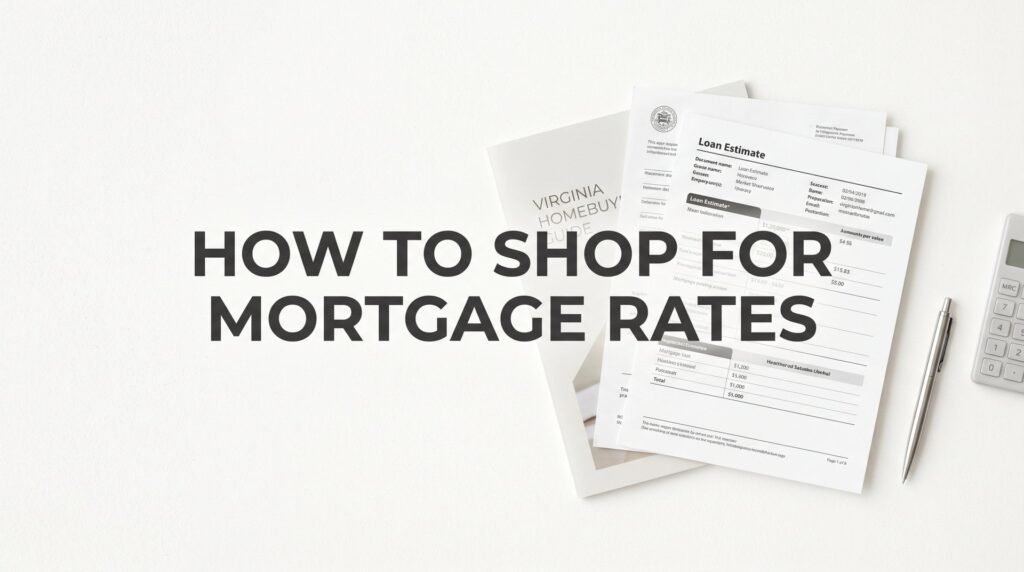
Start with the Loan Estimate. Under federal law, lenders must provide a standardized Loan Estimate (LE) within three business days of receiving a completed loan application. This three-page document is your primary comparison tool. Verify this requirement directly at the CFPB’s website.
Here is what to examine on each page:
Page 1 — The Basics: Interest rate (the rate used to calculate your monthly payment), APR (the rate plus lender fees, expressed as an annualized cost — always higher than the interest rate), loan amount, loan term, and estimated monthly principal and interest payment.
Page 2 — The Costs: Origination charges (lender fees), discount points paid to buy down the rate, and third-party fees (appraisal, title, settlement). This is where lenders differ most dramatically. Understanding mortgage closing costs in detail before you receive your Loan Estimate will help you spot inflated fees immediately.
Discount Points and Breakeven Math — A Worked Example:
Loan amount: $350,000, 30-year fixed rate, purchase transaction.
Option A: Rate 6.875%, zero points, origination fee $1,500. Monthly P&I payment: approximately $2,299.
Option B: Rate 6.500%, one discount point ($3,500), same origination fee $1,500. Monthly P&I payment: approximately $2,212.
Monthly savings with Option B: $2,299 minus $2,212 equals $87 per month.
Cost of buying the point: $3,500.
Breakeven calculation: $3,500 divided by $87 equals approximately 40 months, or about 3 years and 4 months.
If you plan to stay in the home — or keep the loan — beyond 40 months, buying the point makes financial sense. If you expect to sell or refinance before that point, you are paying upfront for savings you will never collect. This is the breakeven framework — and understanding how mortgage points work is essential before you apply it to every points scenario you encounter.
Side-by-Side Lender Comparison Table Structure:
Lender A: Rate 6.875% | APR 7.012% | Points 0 | Origination $1,500 | Monthly P&I $2,299 | Total cost at 5 years $139,940
Lender B: Rate 6.500% | APR 6.821% | Points 1 ($3,500) | Origination $1,500 | Monthly P&I $2,212 | Total cost at 5 years $138,220
Lender C: Rate 7.125% | APR 7.125% | Points 0 | Origination $0 | Monthly P&I $2,357 | Total cost at 5 years $141,420
Lender D (Broker/Wholesale): Rate 6.375% | APR 6.598% | Points 0.5 ($1,750) | Origination $995 | Monthly P&I $2,184 | Total cost at 5 years $132,790
Notice that Lender C has no origination fee — but its rate is the highest, making it the most expensive option over five years. Lender D, a wholesale broker quote, has a lower rate with fewer points than Lender B, demonstrating the broker pricing advantage discussed in the next step.
Tip: Request all quotes on the same day. Mortgage rates change daily and sometimes intraday based on bond market movements. A quote received Monday and compared to one received Thursday is not a valid comparison. Same-day quotes are the only apples-to-apples comparison.
Step 5: Understand the Broker Advantage — One Application, Hundreds of Lenders
Here is a structural reality of the mortgage market that most borrowers never learn: not all lenders have access to the same rates. Where you apply matters as much as how you apply.
Retail lender: A bank, credit union, or direct lender like Rocket Mortgage, Movement Mortgage, PrimeLending, Alcova Mortgage, CapCenter, or Atlantic Bay Mortgage operates from its own internal rate sheet. When you apply there, you are choosing from that institution’s product shelf — and only that shelf. Their loan officers can offer you what their company approves, nothing more. If you are evaluating these options, reviewing proven Rocket Mortgage alternatives can help you understand the full competitive landscape.
Mortgage broker: A licensed broker like The Mortgage Ally submits one application and receives competing wholesale pricing from hundreds of lenders simultaneously. Wholesale rates are typically lower than retail rates because the lender is not paying for the retail distribution infrastructure — the broker handles the client relationship.
The honest comparison looks like this:
Retail Lender (e.g., Rocket Mortgage, Movement Mortgage, PrimeLending): One rate sheet, one product shelf, in-house processing, rates include retail margin, limited ability to shop on your behalf.
Mortgage Broker (e.g., The Mortgage Ally): Access to hundreds of wholesale lenders, one application, competing wholesale pricing, broker shops on your behalf, rate challenge capability.
This is not a criticism of retail lenders — many of them provide excellent service and competitive products. The distinction is structural. Understanding the key differences in a mortgage broker vs bank comparison helps clarify why a broker’s business model is built around finding the best available price across a wide market, while a retail lender’s model is built around selling its own products efficiently.
The rate challenge concept works like this: if you have already received a quote from a retail lender or another broker, bring that Loan Estimate to The Mortgage Ally. Using access to hundreds of wholesale lenders, the goal is to beat that offer on rate, fees, or both. You have nothing to lose by asking.
Virginia-specific note: The Mortgage Ally serves borrowers throughout Richmond, Chesterfield, Henrico, Hanover, Fredericksburg, Spotsylvania, Stafford, Prince William, Williamsburg, Charlottesville, Virginia Beach, Chesapeake, Newport News, Suffolk, Roanoke, Lynchburg, Short Pump, Glen Allen, Midlothian, Goochland, Lake Anna, Louisa, and surrounding communities. The same wholesale lender access applies regardless of which Virginia market you are buying or refinancing in.
Important question to ask any broker: How many wholesale lenders do you actively work with? Not all brokers have the same lender relationships. A broker with a limited panel of three or four lenders offers far less competitive advantage than one with access to a broad wholesale marketplace.
Tip: If you have already received a retail quote, do not accept it as your only option. Bring it to a broker and let the wholesale market respond. The worst outcome is confirmation that your existing offer is already competitive. The best outcome is a meaningfully lower rate or reduced fees.
Step 6: Lock Your Rate at the Right Time
You have done the work: you know your credit profile, you have gathered your documents, you have compared Loan Estimates, and you have identified the best offer. Now comes a decision that borrowers often underestimate: when to lock.
A rate lock is a lender’s written commitment to hold a specific interest rate for a defined period while your loan moves through processing and underwriting. Common lock periods are 30, 45, and 60 days. Longer locks typically cost more — either through a slightly higher rate or a lock fee. For a complete breakdown of how this works, see our guide on mortgage rate lock strategies before you make this decision.
The timing dilemma: Lock too early and you risk expiration fees if your closing is delayed. Lock too late and rates may move against you before you close. There is no perfect answer, but there is a framework for making a better decision.
Float-down options: Some lenders offer a float-down provision, which allows your rate to drop one time if market rates fall by a defined amount before closing. Ask specifically about this feature when comparing lenders — it is not universally available, and the terms vary significantly. A float-down can provide meaningful downside protection in a declining rate environment.
What causes rate lock extensions — and how to avoid them:
1. Appraisal delays — order the appraisal immediately after going under contract. Do not wait.
2. Title issues — title searches occasionally surface liens, boundary disputes, or ownership gaps that require resolution before closing.
3. Document gaps — missing bank statements, unsigned disclosures, or employer verification delays are the most common causes of preventable extensions. This is why Step 3 matters.
4. Underwriting conditions — lenders may issue conditions requiring additional documentation. Respond to these within 24 hours whenever possible.
To monitor where rates are heading, use publicly available data. The Freddie Mac Primary Mortgage Market Survey publishes weekly average rate data at freddiemac.com/pmms. The CFPB also provides mortgage rate context at consumerfinance.gov/owning-a-home. These tools give you a directional sense of the market without requiring you to interpret bond yields or Fed policy statements.
Tip: In a volatile rate environment, a 45-day lock on a purchase transaction provides more buffer than a 30-day lock. Calculate the cost of a lock extension — typically 0.125% to 0.25% of the loan amount — versus the cost of the longer lock upfront. In most cases, the longer lock is the better insurance policy.
Putting It All Together: Your Mortgage Rate Shopping Checklist
Here is the complete process in a single, scannable checklist:
1. Know your five rate drivers: credit score tier, LTV, loan type, loan term, and property type.
2. Pull your credit reports at AnnualCreditReport.com. Identify errors, collections, high utilization, or thin file issues before any lender sees your profile.
3. Use a soft-pull pre-qualification (NoTouch Credit / Vantage Score 4.0) to establish a realistic rate range with zero credit score impact.
4. Gather documents organized by borrower type: W-2, self-employed/bank statement, or DSCR investor.
5. Request Loan Estimates from multiple lenders on the same day. Compare rate, APR, points, origination fees, and total cost over your expected hold period.
6. Apply the breakeven calculation to any discount point scenario before paying upfront costs.
7. Consider a mortgage broker’s access to hundreds of wholesale lenders as your rate-shopping multiplier.
8. Lock your rate with a period that matches your expected closing timeline, and ask about float-down provisions.
This process applies equally to purchase loans, refinances, and HELOCs. The steps are the same regardless of loan purpose.
Virginia loan limit reference: The 2025 conforming loan limit baseline was $806,500 for single-family properties — verify the current 2026 figure at fhfa.gov. FHA loan limits vary by Virginia county — check current figures at HUD.gov. VA loans have no loan limit for eligible veterans with full entitlement — details at VA.gov.
Frequently Asked Questions
Q: Does shopping for mortgage rates hurt my credit score?
A: Not significantly, and not if you do it strategically. FICO scoring models treat multiple mortgage-related hard inquiries within a 14 to 45 day window as a single inquiry. Additionally, using a soft-pull pre-qualification (NoTouch Credit) during early exploration results in zero credit impact. Source: myFICO.com.
Q: How many lenders should I get quotes from?
A: At minimum, three to four Loan Estimates on the same day. Working with a mortgage broker effectively multiplies this — one application goes to hundreds of wholesale lenders simultaneously, giving you far broader market coverage than applying to retail lenders individually.
Q: What is the difference between interest rate and APR?
A: The interest rate is the cost of borrowing the principal, expressed as a percentage. The APR (Annual Percentage Rate) includes the interest rate plus lender fees, expressed as an annualized figure. APR is always higher than the interest rate. When comparing lenders, APR gives you a more complete cost picture — but total cost over your expected hold period is the most accurate metric of all.
Q: Can I shop for rates if my credit score is below 620?
A: Yes. FHA loans are available with scores as low as 580 (with 3.5% down) or 500 (with 10% down). VA loans have no VA-set minimum, though most lenders require 580 to 620. That said, if your score is below 620 on a conventional loan, addressing it before applying will produce meaningfully better pricing. Even a 20-point improvement can shift your rate tier.
Q: How does a mortgage broker help me get a lower rate?
A: A mortgage broker submits one application and receives competing wholesale pricing from hundreds of lenders simultaneously. Wholesale rates are typically lower than retail rates because the lender is not absorbing retail distribution costs. The broker also allows you to bring a competing offer and attempt to beat it using their lender network — a rate challenge that costs you nothing to attempt.
Rates shown in worked examples throughout this article are illustrative only and do not constitute a commitment to lend. All loans are subject to credit approval, property appraisal, income verification, and underwriting guidelines. Loan program availability and terms may vary. This content is for educational purposes only. The Mortgage Ally is an equal housing lender. Licensed in Virginia, Florida, Tennessee, and Georgia. Duane Buziak NMLS#1110647.
Ready to put this process to work? Learn more about our services and see how The Mortgage Ally’s access to hundreds of lenders — combined with a NoTouch Credit soft pull — can surface your most competitive rate options without any impact to your credit score.