
Updated September 2026 | By Duane Buziak, Mortgage Maestro, NMLS #1110647 — MortgageAlly
Choosing a mortgage lender is one of the most consequential financial decisions you’ll make as a homebuyer — yet most people default to the first name their real estate agent mentions or the biggest brand they see advertised online. That instinct is understandable, but it can cost you tens of thousands of dollars over the life of your loan.
At MortgageAlly, we’ve seen firsthand how much the lender selection decision matters: the difference between lenders isn’t just a fraction of a percent on your interest rate. It’s the total cost of your loan over 30 years, the speed of your closing, the transparency of your fees, and whether someone actually picks up the phone when you need answers. On a $400,000 loan, a 0.5% rate difference alone represents more than $47,000 in additional interest over a 30-year term — that’s real money, and it’s why shopping lenders carefully is worth every hour you invest in it.
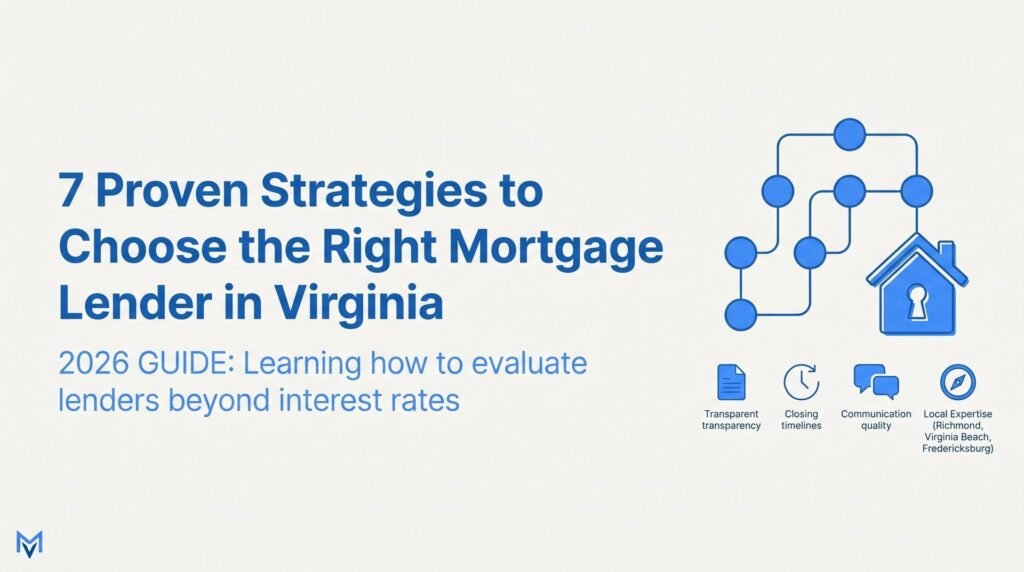
This guide walks you through seven concrete strategies to evaluate and select a mortgage lender anywhere in the country. Whether you’re purchasing your first home, refinancing an existing loan, or financing an investment property, each strategy includes actionable steps you can take today — plus breakeven math so you can see exactly how each decision impacts your wallet.
Every number cited here is independently verifiable or clearly labeled as illustrative. No fabricated statistics. No vague promises. Just a practical framework for one of the smartest financial decisions of your life.
Rates and loan terms referenced throughout this article are current as of September 2026. Rate markets move daily; always verify current quotes directly with your lender. This article is for educational purposes only and does not constitute a commitment to lend or an offer of credit. NMLS #1110647. Equal Housing Lender.
1. Understand the Three Types of Mortgage Lenders (And What Each Costs You)
The Challenge It Solves
Most Virginia homebuyers don’t realize there are fundamentally different business models operating under the umbrella term “mortgage lender.” Picking the wrong type for your situation doesn’t just mean a slightly higher rate — it can mean limited product access, slower processing, or fees baked invisibly into your loan that you never see itemized.
The Strategy Explained
There are three primary lender structures you’ll encounter in Virginia’s mortgage market.
Direct Lenders (Banks and Credit Unions): These institutions lend their own money and underwrite in-house. Examples include large national banks and regional credit unions. They set their own rates, control their own timelines, and have a fixed product menu. If their products fit your profile, they can be efficient. If they don’t, you’re stuck.
Online-Only Lenders: Companies like Rocket Mortgage operate as direct lenders with a digital-first interface. They often have streamlined technology and fast initial processing, but their product range is still limited to what that single institution offers. Rate shopping means going back and applying again elsewhere.
Mortgage Brokers: Brokers don’t lend their own money. Instead, they access hundreds of wholesale lenders simultaneously, including lenders not available to the general public. A broker submits your file once and shops it across that entire network. The Mortgage Ally operates as a broker, which means access to hundreds of lenders with a single application and a single credit conversation. Learn more about how this model works in our guide to finding the best mortgage brokers in Virginia.
The structural difference matters because a broker’s competitive advantage is volume and access. Wholesale lenders offer brokers pricing that individual consumers typically cannot access directly.
Implementation Steps
1. Ask every lender you speak with: “Are you a direct lender, a correspondent lender, or a mortgage broker?” This single question clarifies their business model and product access.
2. Ask direct lenders how many loan products they offer. Ask brokers how many wholesale lenders they work with. Compare those numbers.
3. Identify whether your loan scenario is straightforward (W-2 income, strong credit, conventional purchase) or complex (self-employed, investor, jumbo, VA). Complex scenarios benefit more from broker access to specialized lenders.
Pro Tips
Don’t assume a big brand name means better pricing. Large retail lenders carry significant overhead — branch networks, advertising budgets, large sales teams — and those costs are often reflected in their rates and fees. A broker working on wholesale pricing frequently delivers more competitive terms on an apples-to-apples comparison.
2. Compare Loan Estimates Side by Side — Not Just the Interest Rate
The Challenge It Solves
The interest rate is the number every lender leads with in marketing. It’s also the number that tells you the least about the true cost of your loan. Two lenders can quote the same rate while charging dramatically different fees — and the one with the lower rate can actually cost you more at closing and over time.
The Strategy Explained
Federal law requires lenders to provide a standardized Loan Estimate (LE) within three business days of receiving your application. This document is your apples-to-apples comparison tool. The key figures to compare across Loan Estimates include the Annual Percentage Rate (APR), origination charges, discount points, and the total closing costs on Page 2.
The APR incorporates the interest rate plus most lender fees, expressed as an annualized cost. A lender offering 6.875% with $3,000 in origination fees may have a higher APR than a lender offering 6.99% with zero origination fees, depending on the loan amount and term. For a deeper breakdown of what these fees actually include, see our guide to mortgage closing costs in Virginia.
Discount points deserve special attention. One point equals one percent of the loan amount, paid upfront to buy down your rate. Points are not inherently good or bad — they depend entirely on how long you stay in the home. The breakeven math for points is covered in detail in Strategy 7.
To make this comparison meaningful, request Loan Estimates from at least three lenders on the same day, for the same loan amount, property type, and down payment. Rate markets move daily, so same-day requests are essential for a valid comparison.
Implementation Steps
1. Request Loan Estimates from at least three lenders on the same day. Specify the same loan amount, property value, loan term, and down payment for each request.
2. Compare Section A (Origination Charges) on Page 2 of each LE. This is where lender-controlled fees live. Third-party fees (appraisal, title) are similar across lenders.
3. Compare the APR column, not just the interest rate. If the APR spread between lenders is wider than the interest rate spread, fees are the differentiator.
Pro Tips
Bring your best competing Loan Estimate to your preferred lender and ask them to match or beat it. Many lenders have pricing flexibility that isn’t reflected in their initial quote. This negotiation step alone can save hundreds to thousands of dollars in origination fees. Our mortgage rate comparison guide walks through this process in more detail.
3. Protect Your Credit Score While Rate Shopping
The Challenge It Solves
One of the most common fears Virginia homebuyers express is this: “If I apply with multiple lenders, won’t that hurt my credit score?” This concern causes many buyers to stop at one lender, eliminating competition and often leaving money on the table. The fear is understandable but largely misplaced when you understand how mortgage inquiries actually work.
The Strategy Explained
FICO, the company behind the most widely used credit scoring models, officially states that multiple mortgage-related credit inquiries within a 45-day window are treated as a single inquiry for scoring purposes. This is called inquiry deduplication, and it exists specifically to encourage consumers to rate shop without penalty. You can verify this directly at myfico.com.
In practical terms: applying with five mortgage lenders in a two-week period has the same credit impact as applying with one. The damage to your score from a single mortgage inquiry is typically small and temporary.
Beyond the FICO window, there’s an additional layer of protection available through soft-pull pre-qualification. The Mortgage Ally offers a NoTouch Credit pre-qualification process that uses a soft credit pull — the kind that has zero impact on your credit score — to give you a preliminary picture of your loan options. This is ideal for the early exploration phase before you’re ready to formally apply.
Vantage Score 4.0, which The Mortgage Ally also utilizes, is increasingly used by lenders for initial qualification assessments. Understanding which scoring model a lender uses matters when evaluating your credit position.
Implementation Steps
1. Start with a soft-pull pre-qualification to understand your baseline loan options without any credit impact. This gives you a realistic price range before you begin formally applying.
2. When you’re ready to formally compare Loan Estimates, submit all applications within a 14 to 45-day window to maximize the FICO inquiry deduplication benefit. Tighter windows (14 days) are safer across all FICO model versions.
3. Avoid applying for any other new credit (credit cards, auto loans) during your mortgage shopping period. Mortgage inquiries are protected; other inquiries are not.
Pro Tips
Ask each lender upfront whether their pre-qualification process uses a hard or soft pull. Any lender requiring a hard pull just to give you a rate estimate is creating unnecessary friction. A soft pull is sufficient for preliminary qualification in most cases. Our guide on mortgage pre-approval without a hard inquiry explains exactly how this works.
4. Evaluate Lender Speed, Communication, and Closing Timelines
The Challenge It Solves
In competitive Virginia markets like Short Pump, Glen Allen, and Chesterfield, sellers and their agents evaluate the strength of your offer partly on your lender’s reputation for closing on time. A lender who misses a closing date doesn’t just inconvenience you — it can cost you the home entirely if the seller walks. Service quality is a financial variable, not just a comfort preference.
The Strategy Explained
Closing timelines vary significantly by lender type. Large retail banks and online lenders often quote 30 to 45-day closing windows as standard. Brokers with strong wholesale lender relationships can frequently close faster, sometimes in as few as 15 to 21 days for well-documented files.
Beyond speed, the quality of communication throughout the process matters enormously. Will you have a single point of contact who knows your file, or will you be passed between departments? Can you reach someone after 5 PM or on weekends? When your loan is in underwriting and you need a quick answer, who do you call? Understanding the full mortgage approval process helps you know what to expect at each stage.
These are not soft, intangible factors. They directly affect whether your loan closes on schedule, whether you can respond quickly to underwriting conditions, and whether your real estate agent will recommend you as a prepared buyer to future sellers.
Implementation Steps
1. Ask each lender directly: “What is your average closing timeline for a purchase loan?” and “What is your fastest close on record?” Listen for specificity. Vague answers suggest the lender doesn’t track this data closely.
2. Ask: “Who is my single point of contact throughout the process, and what are their direct contact hours?” If the answer involves a call center or a rotating team, factor that into your decision.
3. Ask your real estate agent which lenders they’ve had positive closing experiences with in your target market. Agents transact frequently and have direct insight into which lenders perform under pressure.
Pro Tips
Request a pre-approval letter, not just a pre-qualification letter. A pre-approval involves verified income and asset documentation, which gives sellers and listing agents confidence that your financing is solid. Our step-by-step guide on how to get mortgage pre-approval in Virginia walks you through the entire process.
5. Match Your Loan Type to the Right Lender’s Strengths
The Challenge It Solves
Not every lender offers every loan product, and among lenders who technically offer a product, expertise and pricing vary significantly. A lender who primarily processes conventional loans may technically offer VA loans but lack the specialized knowledge to navigate VA appraisal requirements, funding fee exemptions, or entitlement restoration. That knowledge gap costs you time, money, and sometimes the deal.
The Strategy Explained
Match your loan scenario to a lender with demonstrated depth in that product. Here’s a practical framework for Virginia borrowers:
Conventional Loans: Most lenders offer these. The conforming loan limit for 2025 in most Virginia counties is $806,500 (verify the current limit at fhfa.gov). Competition is strong, so rate and fee comparison matters most here. Review our breakdown of conventional loan requirements to see if this product fits your profile.
FHA Loans: FHA loans are administered through HUD-approved lenders. Minimum credit score requirements and debt-to-income guidelines are set by HUD (see hud.gov). Look for lenders who close FHA loans regularly and understand FHA appraisal standards.
VA Loans: VA loans require lender approval from the Department of Veterans Affairs. Verify VA loan information at va.gov. Lenders who specialize in veteran loans understand Certificate of Eligibility requirements, funding fee structures, and VA appraisal timelines — details that matter for veterans in Hampton Roads, Williamsburg, and Yorktown.
Jumbo Loans: Loan amounts above the conforming limit require lenders with specific jumbo portfolio capacity. Not all lenders have this. Brokers with access to multiple wholesale investors often have more competitive jumbo pricing than single-institution lenders.
DSCR Loans (Debt Service Coverage Ratio): These are non-QM loans designed for real estate investors who qualify based on rental income rather than personal income. They require lenders with non-QM expertise. Investors purchasing near Fredericksburg, Lake Anna, or in the Richmond metro should specifically ask whether a lender offers DSCR products and what their minimum DSCR ratio requirement is.
HELOC (Home Equity Line of Credit): Home equity lines have their own product-specific requirements. The Mortgage Ally offers cash-out refinances up to 90% LTV, which is worth comparing against HELOC options depending on your equity position and rate environment.
Implementation Steps
1. Identify your loan type before you begin lender outreach. This single step narrows your lender pool significantly and focuses your conversations.
2. Ask each lender: “How many [loan type] loans did you close in the last 12 months?” Volume indicates genuine expertise, not just technical availability.
3. For specialized products (VA, DSCR, jumbo, non-QM), ask for a brief explanation of how that product works. A lender who truly specializes can explain the nuances clearly and quickly.
Pro Tips
If you’re a Virginia veteran, don’t assume the largest VA-branded lenders offer the best terms. Veterans United and similar companies specialize in VA loans and have strong processes, but a broker with access to multiple VA-approved wholesale lenders may offer more competitive pricing. Compare Loan Estimates directly.
6. Verify Licensing, Read Reviews, and Check Complaint Records
The Challenge It Solves
The mortgage industry is regulated, but that doesn’t mean every lender operates with the same level of professionalism, transparency, or compliance. Before you hand over your financial documents and trust a lender with the largest transaction of your life, you have access to free public tools that let you verify exactly who you’re dealing with.
The Strategy Explained
Three verification resources every Virginia homebuyer should use before committing to a lender:
NMLS Consumer Access: The Nationwide Multistate Licensing System maintains a public database of all licensed mortgage professionals and companies. You can verify any lender’s license status, check for disciplinary actions, and confirm they are authorized to operate in Virginia. Access it at nmlsconsumeraccess.org. When working with The Mortgage Ally, you can verify Duane Buziak directly: NMLS#1110647.
CFPB Complaint Database: The Consumer Financial Protection Bureau maintains a public database of consumer complaints against financial institutions. Search by company name to see complaint volume and resolution patterns. Access it at consumerfinance.gov/complaint. High complaint volume relative to loan volume, or patterns of unresolved complaints, are meaningful red flags.
Virginia Bureau of Financial Institutions: Virginia regulates mortgage lending through the State Corporation Commission’s Bureau of Financial Institutions. You can verify state-level licensing and check for enforcement actions at scc.virginia.gov/pages/Bureau-of-Financial-Institutions.
Beyond regulatory databases, read Google reviews, Zillow lender reviews, and any available Yelp or Facebook reviews — but read them critically. Look for patterns in negative reviews (communication failures, closing delays, surprise fees at closing) rather than focusing on any single outlier review. Understanding home loan requirements ahead of time also helps you spot lenders who aren’t being transparent about qualification standards.
Implementation Steps
1. Look up every lender you’re considering on NMLS Consumer Access before submitting any application. Confirm their license is active and in good standing in Virginia.
2. Search the CFPB complaint database for each lender. Note the total number of complaints and whether responses were timely and satisfactory.
3. Read at least 10 to 20 reviews per lender, focusing specifically on reviews that mention closing timelines, communication, and fee transparency.
Pro Tips
Ask the lender directly: “Can you provide references from recent clients in Virginia?” A lender confident in their service record will have no hesitation. A reluctant or evasive response tells you something useful about their track record.
7. Run the Full Breakeven Math Before You Commit
The Challenge It Solves
Most borrowers compare lenders based on rate alone, or they look at monthly payment differences without accounting for upfront costs. Neither approach tells you which offer actually costs less over your expected time in the home. Breakeven math closes that gap — and it frequently reveals that the “better” rate isn’t the better deal.
The Strategy Explained
Breakeven analysis answers one question: how long does it take for the savings from a lower rate (or lower payment) to offset the higher upfront cost required to get it?
The most common scenario involves discount points. A lender offers you two options: a 7.00% rate with no points, or a 6.75% rate with one point (1% of the loan amount paid upfront). Which is better? It depends entirely on how long you keep the loan. Our detailed guide on mortgage points explained breaks down exactly when buying points makes financial sense.
Here is a detailed illustrative example using a $400,000 loan amount. These numbers are hypothetical examples for educational purposes only and are not rate commitments or offers to lend.
Scenario A: 7.00% rate, 30-year fixed, zero points. Monthly principal and interest payment: approximately $2,661. Total upfront cost for points: $0.
Scenario B: 6.75% rate, 30-year fixed, one point ($4,000 upfront). Monthly principal and interest payment: approximately $2,594. Monthly savings versus Scenario A: approximately $67.
Breakeven Calculation: Upfront cost of points ($4,000) divided by monthly savings ($67) equals approximately 60 months, or 5 years. If you stay in the home and keep this loan for more than 5 years, Scenario B costs less overall. If you sell, refinance, or pay off the loan before 5 years, Scenario A was the better choice.
The same logic applies when comparing two lenders with different rate and fee combinations. The lender with the lower rate but higher origination fees may cost more if you plan to refinance within three years. The lender with the higher rate but zero fees may be the smarter choice for a short-horizon borrower.
Here is a rate and payment comparison table for a $400,000 loan at various rates. These are illustrative examples only — not rate commitments.
| Interest Rate | Monthly P&I | Total Interest (30 yr) |
|---|---|---|
| 6.50% | ~$2,528 | ~$510,177 |
| 6.75% | ~$2,594 | ~$534,041 |
| 7.00% | ~$2,661 | ~$558,036 |
| 7.25% | ~$2,728 | ~$582,159 |
Payments shown are principal and interest only. Taxes, insurance, and HOA fees are not included. Illustrative calculations only — not rate quotes. Rates and terms subject to change. Not a commitment to lend.
The difference between 6.50% and 7.00% on a $400,000 loan is approximately $133 per month, or roughly $47,859 in total interest over 30 years. That is the real cost of not shopping lenders carefully.
Implementation Steps
1. Gather the total upfront cost and monthly payment from each of your top two lender offers. Include origination fees, discount points, and any lender credits in your upfront cost calculation.
2. Calculate the monthly payment difference between the two offers.
3. Divide the difference in upfront costs by the monthly payment savings to get your breakeven month. Compare that number to your expected time in the home before selling or refinancing.
Pro Tips
Don’t forget to factor in lender credits, which are the opposite of discount points. A lender may offer you a slightly higher rate in exchange for a credit toward your closing costs. This can make sense if you’re short on cash at closing or plan to refinance within a few years. Run the same breakeven math in reverse to evaluate whether accepting a lender credit is worth the higher rate over your expected loan horizon.
Frequently Asked Questions: Choosing a Mortgage Lender in Virginia
Q: How many mortgage lenders should I compare before deciding?
A: At minimum, compare three lenders — ideally including one direct lender, one online lender, and one independent mortgage broker. Research consistently shows that obtaining even one additional quote can save borrowers thousands of dollars over the life of the loan. The Mortgage Ally makes this easier by shopping hundreds of wholesale lenders with a single application.
Q: Does shopping multiple lenders hurt my credit score?
A: No, as long as you submit all mortgage applications within a 45-day window. FICO’s inquiry deduplication rules treat all mortgage-related hard pulls in that window as a single inquiry. Even better, use a soft-pull pre-qualification first — The Mortgage Ally’s NoTouch Credit process lets you explore your options with zero credit impact.
Q: What is the difference between a mortgage broker and a direct lender?
A: A direct lender uses its own funds and offers only its own loan products. A mortgage broker like The Mortgage Ally shops a wholesale network of hundreds of lenders, giving you access to more products, competitive wholesale pricing, and a genuine market comparison — all through a single application at no cost to you.
Q: What Virginia-specific factors should I consider when choosing a lender?
A: Virginia’s conforming loan limit for 2025 is $806,500 in most counties (verify at fhfa.gov). Veterans near Hampton Roads installations should prioritize lenders with genuine VA loan depth. Buyers in competitive Northern Virginia suburbs should weight closing speed heavily. Investors in the Richmond metro and Lake Anna area should confirm whether DSCR products are available. Licensing can be verified at nmlsconsumeraccess.org — Duane Buziak, NMLS #1110647, is licensed in Virginia, Florida, Tennessee, and Georgia.
Q: What is a Loan Estimate and why does it matter?
A: A Loan Estimate (LE) is a standardized federal disclosure a lender must provide within three business days of your application. It shows your interest rate, APR, monthly payment, and all closing costs in a uniform format — making true apples-to-apples comparisons possible. Always request LEs from all lenders on the same day for the same loan parameters. See our mortgage closing costs guide for a full breakdown of what these numbers mean.
Q: How do I verify a mortgage lender’s license in Virginia?
A: Use three free resources: NMLS Consumer Access for national licensing status, the CFPB Complaint Database for consumer complaint history, and the Virginia Bureau of Financial Institutions for state-level enforcement actions. Each check takes only a few minutes and can protect you from serious problems.
Putting It All Together: Your Lender Selection Checklist
Choosing a mortgage lender is not about finding the lowest advertised rate. It’s about finding the right combination of total cost, product fit, service quality, and verified credibility for your specific situation. Here’s how to sequence the seven strategies into a practical action plan.
Step 1 — Identify your loan type first (Strategy 5). Know whether you need conventional, FHA, VA, jumbo, DSCR, or HELOC financing before you speak to a single lender. This determines which lenders are even worth your time.
Step 2 — Start with a soft-pull pre-qualification (Strategy 3). Use a NoTouch Credit pre-qualification to understand your options without any credit impact. This gives you a realistic budget before formal applications begin.
Step 3 — Request Loan Estimates from at least three lenders (Strategies 1 and 2). Include at least one broker, one direct lender, and one online lender. Request all estimates on the same day for the same loan parameters. Compare APR, origination fees, and total closing costs — not just the interest rate.
Step 4 — Evaluate communication and closing speed (Strategy 4). Ask direct questions about timelines, single-point-of-contact availability, and your real estate agent’s experience with each lender. In competitive Virginia markets, a lender’s reputation for closing on time is a genuine competitive advantage for your offer.
Step 5 — Verify licensing and review complaint records (Strategy 6). Check NMLS Consumer Access, the CFPB complaint database, and the Virginia Bureau of Financial Institutions for every lender on your shortlist. This step takes 15 minutes and can save you from a serious problem.
Step 6 — Run breakeven math on your top two choices (Strategy 7). Calculate the exact month at which the better-rate offer pays for its higher upfront cost. Compare that to your expected time in the home. Let the math make the final call.
The Mortgage Ally serves homebuyers, homeowners, and investors across Virginia — including Richmond, Short Pump, Glen Allen, Chesterfield, Midlothian, Henrico, Fredericksburg, Spotsylvania, Stafford, Charlottesville, Hampton Roads, Chesapeake, Virginia Beach, Newport News, Williamsburg, Roanoke, and Lynchburg — as well as borrowers in Florida, Tennessee, and Georgia. As a mortgage broker, The Mortgage Ally shops hundreds of wholesale lenders with a single application, using a soft-pull pre-qualification that protects your credit score from the start.
Ready to see what your options actually look like? Learn more about our services and request a free mortgage rate quote — no credit hit required to get started.
Legal Disclaimer: Rates and terms subject to change without notice. This article is for educational purposes only and does not constitute a commitment to lend or an offer of credit. Rate and payment examples shown are illustrative calculations only and are not rate quotes. Actual rates, payments, and terms depend on individual creditworthiness, loan type, property characteristics, and market conditions at the time of application. NMLS#1110647. Licensed in Virginia, Florida, Tennessee, and Georgia. Equal Housing Lender.
Author: Duane Buziak, Mortgage Maestro, NMLS#1110647