

You’ve spent the last hour bouncing between mortgage calculator websites, and somehow the monthly payment estimate for the same $350,000 home in Glen Allen ranges from $2,100 to $2,650. One calculator says you can afford it comfortably. Another suggests you’re stretching too thin. A third throws in costs you’ve never even heard of. Which one is telling you the truth?
Here’s the reality: most online mortgage calculators aren’t designed to give you accurate estimates—they’re designed to collect your contact information. The difference between a helpful financial planning tool and a glorified lead generation form comes down to what data they include, whether they account for Virginia-specific costs, and most importantly, whether they’re pulling from real lender rates or just using national averages that have nothing to do with what you’ll actually pay in Chesterfield or Virginia Beach.
The most accurate mortgage estimates don’t come from generic online calculators. They come from tools backed by real lender data and local market expertise. When you work with a mortgage broker who has access to hundreds of lenders—not just one product suite—you’re getting estimates based on actual competitive rates, not whatever a single lender happens to be offering this week. And with The Mortgage Ally’s NoTouch Credit Solutions, you can verify those estimates with real pre-qualification numbers without the credit hit that comes with shopping around at multiple direct lenders.
Why Most Online Mortgage Calculators Miss the Mark
Pull up any generic mortgage calculator, and you’ll see the same basic inputs: home price, down payment, interest rate, loan term. Plug in your numbers, and out pops a monthly payment estimate. Simple, right? The problem is that simplicity comes at the cost of accuracy.
Most calculators use national average interest rates—rates that might reflect what borrowers are getting in Ohio or Arizona, but tell you nothing about current Virginia market conditions. When Rocket Mortgage or Penny Mac show you an interest rate estimate, they’re often displaying their own advertised rates, which may or may not be what you’ll actually qualify for based on your credit profile, down payment, and the specific property you’re buying in Henrico County versus Spotsylvania.
But the rate is just the beginning of what these calculators get wrong. The bigger issue is what they leave out entirely.
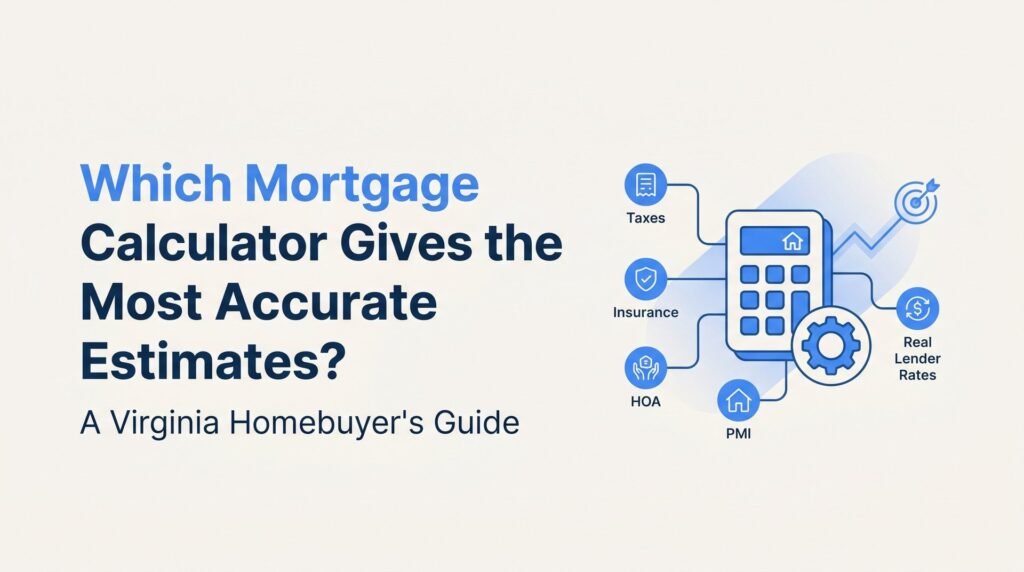
Private Mortgage Insurance (PMI): Put down less than 20%, and you’ll pay PMI—typically 0.5% to 1% of your loan amount annually. That’s an extra $145 to $290 per month on a $350,000 loan. Many basic calculators either exclude this entirely or bury it in fine print.
Property Taxes: This is where Virginia homebuyers get hit with serious sticker shock. Property tax rates vary dramatically across the state. In Richmond, you might pay around $1.20 per $100 of assessed value. In Virginia Beach, it’s closer to $1.00. In Charlottesville, it can be higher. On a $350,000 home, that’s the difference between $350 and $420 per month—a gap most generic calculators completely ignore because they don’t ask for your specific Virginia location.
Homeowner’s Insurance: Coastal properties in Hampton Roads carry higher insurance premiums than homes in Roanoke. Flood zones, proximity to water, and local claim histories all affect your costs. A calculator that assumes a flat national average is giving you fiction, not facts.
HOA Fees: Many newer developments in Short Pump, Midlothian, and other growing Virginia communities come with homeowner association fees ranging from $50 to $400+ monthly. Most calculators don’t even ask if your property has HOA fees.
When you compare Rocket Mortgage’s basic calculator to tools designed for broker use, the difference becomes clear. Single-lender calculators are optimized to show you the lowest possible number to keep you engaged. Broker-backed tools are designed to show you the real number so you can actually plan your finances accurately. One is a marketing tool. The other is a planning tool. Understanding how to use a home loan calculator effectively can help you distinguish between the two.
The Five Factors That Determine Calculator Accuracy
Not all mortgage calculators are created equal, and the difference between a useful tool and a misleading one comes down to five critical factors.
Real-Time Rate Data vs. Static Estimates: When you use a calculator from Freedom Mortgage or Veterans United, you’re seeing rates for their specific loan products. That’s not necessarily bad—it’s just limited. These direct lenders can only show you what they’re offering. A mortgage broker with access to hundreds of lenders, including UWM, PrimeLending, Alcova Mortgage, and dozens more, can pull current rates across the entire market. The difference? A direct lender might offer you 6.75% because that’s their product. A broker might find you 6.375% from a different lender whose underwriting criteria better match your profile. That quarter-point difference saves you roughly $60 per month on a $350,000 loan—$21,600 over 30 years.
Location-Specific Inputs: Virginia isn’t a monolith. A mortgage calculator that asks for your zip code or county isn’t being nosy—it’s being accurate. Property tax rates in Hanover County differ from those in Stafford. Insurance costs in flood-prone areas near Lake Anna or Yorktown are higher than in Ashland. Even closing costs vary: some Virginia localities charge transfer taxes, while others don’t. A calculator that treats Richmond the same as Lynchburg is already off by hundreds of dollars before you even get to the interest rate.
Credit Score Integration Without the Hard Pull: Here’s where most Virginia homebuyers get caught in a trap. You want an accurate estimate, so you start requesting quotes from Movement Mortgage, Guild Mortgage, and CrossCountry Mortgage. Each one runs a hard credit inquiry to give you a “real” rate quote. Three inquiries in two weeks, and your credit score drops 15-20 points—potentially pushing you into a higher rate tier that costs you more than if you’d never checked in the first place.
The Mortgage Ally’s NoTouch Credit Solutions approach solves this problem. You get pre-qualification with real rate data from hundreds of lenders without the hard pull. No credit score impact. No penalty for shopping smart. This is a structural advantage that direct lenders simply can’t match—they need your full credit profile to quote their single product. A broker can provide competitive rate ranges based on your stated credit tier, then verify with a single soft pull when you’re ready to move forward.
Comprehensive Cost Inclusion: An accurate calculator doesn’t just ask about the home price and down payment. It asks about your credit score range, your target county in Virginia, whether you’re a first-time buyer (which might qualify you for certain programs), and whether you’re looking at a conventional loan, FHA, VA, or USDA product. Each of these factors changes your rate, your required down payment, and your monthly costs. Knowing the strategies to secure the best conventional loan rates can significantly impact your calculator results.
Lender Fee Transparency: Some lenders charge origination fees. Others don’t. Some offer credits toward closing costs. Others load costs into the rate. A calculator that shows you a great rate but hides a 1% origination fee ($3,500 on a $350,000 loan) isn’t giving you the full picture. The most accurate calculators break down every component: principal, interest, taxes, insurance, PMI, and estimated closing costs.
Head-to-Head: How Virginia Lenders’ Calculators Compare
Let’s look at what you’ll actually find when you start comparing mortgage calculators from lenders operating in Virginia markets.
Atlantic Bay Mortgage, C&F Mortgage Corporation, and Southern Trust Mortgage: These regional players understand Virginia markets better than national brands, and their calculators often include local tax rate data. Atlantic Bay’s tool, for instance, asks for your specific Virginia county—a good sign. Where they fall short is the same place all single-lender calculators struggle: they can only show you their own rates and products. If Atlantic Bay’s current 30-year fixed rate is 6.625%, that’s what you’ll see, even if NFM Lending or Embrace Home Loans might offer you 6.5% based on your profile.
C&F Mortgage Corporation’s calculator does a decent job including PMI and insurance estimates, but like most direct lenders, they’re optimizing for their own product suite. If you don’t fit their ideal borrower profile, you won’t see the competitive rates they advertise.
Southern Trust Mortgage’s tool is straightforward and includes most major cost components, but again—you’re seeing one lender’s offering, not the market.
Movement Mortgage, Guild Mortgage, and CrossCountry Mortgage: These national lenders with strong Virginia presence offer polished calculators with good user experience. Movement Mortgage’s tool is particularly clean and mobile-friendly. The issue isn’t functionality—it’s scope. When you use Movement’s calculator, you’re seeing Movement’s rates. When you use Guild’s, you’re seeing Guild’s rates. You have no way of knowing if these are competitive with what RatePro Mortgage, CapCenter, or Fairway Independent Mortgage might offer for the same scenario.
CrossCountry Mortgage’s calculator includes helpful educational content alongside the numbers, which is valuable for first-time buyers navigating the home purchase process. But educational content doesn’t change the fundamental limitation: one lender, one set of products, one rate card.
Why Single-Lender Calculators Can’t Match Broker Tools: Think of it this way. If you’re shopping for a car and you visit a Honda dealership, their pricing tool will show you Honda prices. Accurate? Sure, for Hondas. But you have no idea if Toyota, Ford, or Mazda might offer better value for your specific needs. You’d need to visit each dealership separately, fill out forms at each one, and compare manually.
A mortgage broker’s calculator is like having access to every dealership’s inventory and pricing at once. When The Mortgage Ally pulls rate data, it’s coming from UWM, PrimeLending, Alcova Mortgage, Prosperity Mortgage, and hundreds more simultaneously. The calculator isn’t showing you one lender’s best guess—it’s showing you what the competitive market looks like for your scenario.
This matters enormously in Virginia’s diverse housing markets. A first-time buyer in Fredericksburg with 5% down and a 680 credit score might get their best rate from one lender. An investor buying a rental property in Williamsburg with 25% down and a 760 score might get the best terms from a completely different lender. Single-lender calculators can’t adapt to these variations. Broker tools can.
Your Mortgage Calculator Questions Answered
Why does Rocket Mortgage show me a different rate than Fairway Independent Mortgage? Because they’re different lenders with different rate cards, different underwriting criteria, and different business models. Rocket Mortgage is a direct lender—they originate and often service their own loans. Their rates reflect their specific costs and profit margins. Fairway Independent Mortgage operates differently in different markets and may have different investor relationships that allow them to offer different rates. Neither is necessarily “wrong”—they’re just showing you their own products. This is exactly why working with a broker who can compare both (plus hundreds of others) gives you a more complete picture. You’re not guessing which lender might be best—you’re seeing actual competitive options.
Will using multiple calculators hurt my credit score? Using calculators themselves? No. Calculators don’t access your credit report—they’re just math tools. The problem comes when you move from calculators to actual rate quotes. If you request official quotes from CapCenter, RatePro Mortgage, and Penny Mac, each one will likely run a hard credit inquiry. Multiple hard inquiries in a short period can temporarily lower your score. Credit scoring models do allow for “rate shopping” within a 14-45 day window (depending on the model), treating multiple mortgage inquiries as a single event, but why risk it? The Mortgage Ally’s NoTouch Credit Solutions lets you get real pre-qualification data without any hard pulls. You can compare actual rates from hundreds of lenders with zero credit score impact.
How can I get accurate estimates without a hard credit inquiry? This is the key question, and it’s where the broker model shines. Direct lenders like Veterans United or NFM Lending need to pull your full credit report to give you an accurate rate quote because they’re underwriting you for their specific products. A mortgage broker can provide accurate rate ranges based on your stated credit tier (you know if you’re in the high 600s, low 700s, or 750+ range), then access rate data from hundreds of lenders without pulling your credit. When you’re ready to move forward with a specific loan, a single soft inquiry verifies your information without the score impact. It’s the difference between “let me check my entire inventory for your needs” versus “let me underwrite you for my one product to see if you qualify.”
What’s the difference between a pre-qualification and a pre-approval, and which gives me more accurate numbers? Pre-qualification is an initial assessment based on information you provide—income, assets, debts, credit score range. It gives you a solid estimate of what you can afford and what rates you might qualify for. Pre-approval goes deeper—it involves verifying your financial information and running a full credit check. Pre-approval gives you more precise numbers and shows sellers you’re a serious buyer. With The Mortgage Ally’s approach, you can get meaningful pre-qualification with real rate data first, then move to pre-approval when you’re ready to make offers—all while minimizing credit inquiries.
Getting Real Numbers: From Calculator Estimates to Verified Rates
Here’s the uncomfortable truth about mortgage calculators: even the good ones are giving you estimates, not guarantees. The gap between what a calculator shows you and what you’ll actually pay comes down to underwriting.
When Prosperity Mortgage or NFM Lending run their underwriting process, they’re verifying everything you told the calculator. They’re checking your actual income documentation, your actual credit report, your actual debt-to-income ratio, and the actual appraisal value of the property you want to buy. Any of these factors can shift your final rate.
Think you have a 720 credit score? If it’s actually 698, you might jump to a different rate tier. Think your debt-to-income ratio is 38%? If the underwriter calculates it at 42%, you might need a different loan product. Think the house will appraise at purchase price? If it comes in low, your loan-to-value ratio changes, and so does your rate.
This is why The Mortgage Ally’s Mortgage Broker of the Year approach matters. The process isn’t just “use a calculator and hope for the best.” It’s a structured path from estimate to verified rate:
Step One: Use a comprehensive calculator that includes Virginia-specific data—property taxes for your target county, insurance estimates for your area, and current market rates from hundreds of lenders.
Step Two: Get pre-qualified with real rate data based on your financial profile, without the credit hit. This is where you move from generic estimates to personalized numbers that reflect your actual situation.
Step Three: When you’re ready to make an offer, move to full pre-approval with documentation and verification. Now you have a locked rate and a clear picture of your actual costs.
Let’s look at how this plays out in real Virginia scenarios. A first-time buyer in Short Pump with $15,000 saved for a down payment might use a calculator and see they can afford a $250,000 home. But when a broker reviews their situation, they might discover this buyer qualifies for a first-time buyer program with down payment assistance, bumping their buying power to $280,000. The calculator was accurate for a conventional loan—it just didn’t know about the other options.
A homeowner refinancing in Fredericksburg might see calculator estimates showing they’ll save $200 monthly by refinancing from 7% to 6%. But when a broker pulls current rates from their full network, they find a lender offering 5.75% with a small credit toward closing costs—saving this homeowner $275 monthly instead. Understanding cash out refinance options can reveal even more opportunities for homeowners with significant equity.
An investor buying a rental property in Williamsburg might use a calculator assuming standard investment property rates, only to discover through a broker that their strong credit profile and 30% down payment qualify them for portfolio lending programs with better terms than conventional investment loans. For real estate investors, exploring strategies for investment property loans can uncover financing options that generic calculators never show.
Putting It All Together
The most accurate mortgage calculator isn’t the one with the prettiest interface or the simplest inputs. It’s the one backed by real lender data, local Virginia market knowledge, and access to multiple loan products across hundreds of lenders.
Generic calculators from national websites give you a starting point, but they’re working with national averages and limited data. Single-lender calculators from companies like Rocket Mortgage, Movement Mortgage, or Veterans United show you accurate numbers for their specific products, but they can’t tell you if a competitor offers better terms. Regional lenders like Atlantic Bay Mortgage, C&F Mortgage Corporation, or Southern Trust Mortgage understand Virginia markets better, but they’re still limited to their own rate cards.
The Mortgage Ally’s approach combines the best of all these elements: access to hundreds of lenders means you’re seeing competitive market rates, not just one company’s offering. Virginia-specific expertise means your estimates account for property taxes in Henrico versus Chesterfield, insurance costs in Hampton Roads versus Roanoke, and closing cost variations across the state. And NoTouch Credit Solutions means you can get real pre-qualification numbers without the credit score impact that comes from shopping around at multiple direct lenders.
Whether you’re a first-time buyer in Glen Allen trying to figure out what you can afford, a homeowner in Midlothian exploring refinancing options, or an investor evaluating rental properties in Chesapeake, the accuracy of your mortgage calculator matters. A few hundred dollars difference in your monthly payment estimate might seem minor when you’re just browsing online. But when you’re making actual financial decisions—deciding how much house to shop for, whether refinancing makes sense, or if an investment property pencils out—those few hundred dollars become the difference between a smart decision and an expensive mistake.
The path to accurate numbers starts with the right tools and the right expertise. Learn more about our services and get a free, no-obligation rate quote that reflects actual Virginia market rates from hundreds of lenders—not generic estimates from a one-size-fits-all calculator. No credit hit. No pressure. Just real numbers from a Mortgage Broker of the Year who has access to the full market, not just one product line.