
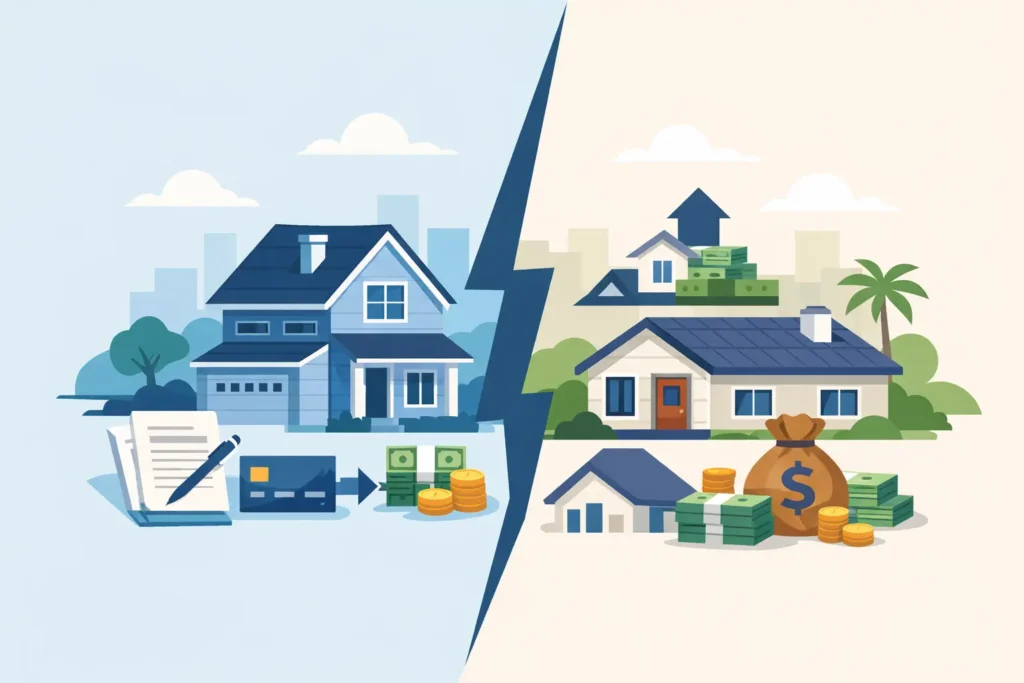

A lot of homeowners ask the wrong first question. It is usually, “Which one has the lower rate?” For a real HELOC vs cash out refinance decision, the better question is, “What are you trying to accomplish, and how long will this debt stay with you?” That shift matters because the cheaper-looking option on day one can become the more expensive one over the next three, five, or ten years.
By Duane Buziak, NMLS #1110647 – mortgage broker, Scotsman Guide Top Originator #114 in 2025, with $95.6M in solo production under one NMLS number.
Table of Contents
- What makes a HELOC different from a cash out refinance
- Worked dollar example with real math
- HELOC vs cash out refinance: side-by-side table
- When a HELOC usually makes more sense
- When a cash out refinance usually makes more sense
- Where homeowners get tripped up
- FAQ
- Important licensing and legal disclaimer
What makes a HELOC different from a cash out refinance
A HELOC is a second mortgage that leaves your current first mortgage in place. You borrow against your equity up to an approved limit, and during the draw period you can usually pull funds as needed rather than taking all the money at once. That makes it useful when your costs will happen in stages, like renovations, tuition, or a longer emergency runway.
A cash out refinance replaces your existing mortgage with a brand-new, larger first mortgage. Part of that new loan pays off the old balance, and the rest comes to you as cash. Instead of managing two loans, you roll everything into one payment.
That sounds simple enough, but the trade-off is where the real decision happens. A HELOC often gives you flexibility and lower upfront friction. A cash out refinance can bring cleaner long-term structure, especially if you want predictability and fixed repayment.
Worked dollar example with real math
Let us use one clean example.
Your home is worth $450,000. Your current first mortgage balance is $220,000. Your current mortgage payment on that first loan is $1,450 a month for principal and interest. You need $60,000 for home improvements and to wipe out higher-interest credit card debt.
Option 1: HELOC
You keep the $220,000 first mortgage exactly as it is and open a $60,000 HELOC as a second lien.
Assume your initial interest-only HELOC payment is 9.00% annual interest. The monthly interest cost on $60,000 is $450.
Now your combined monthly housing-related debt is:
$1,450 existing first mortgage + $450 HELOC interest payment = $1,900 per month.
That looks manageable at first, but if the HELOC rate adjusts higher, your payment can rise. If the draw period ends and the line converts into full principal-and-interest repayment, the payment can jump again.
Option 2: Cash out refinance
You replace the current $220,000 first mortgage with a new $280,000 mortgage. That includes the existing payoff plus the $60,000 cash you want.
Assume the new 30-year fixed payment for principal and interest is $1,840 a month.
Now compare the monthly numbers:
HELOC path: $1,900 monthly total Cash out refinance path: $1,840 monthly total Difference: $60 less per month with the cash out refinance
But monthly payment is not the whole story. With the HELOC, you preserved your current first mortgage instead of replacing it. If that existing first mortgage has a very favorable rate or is already well into repayment, giving it up may cost you more over time even if the new blended payment looks decent. On the other hand, if you only need temporary access to funds and expect to pay the balance down fast, a HELOC can still win because you may avoid refinancing your entire mortgage balance.
HELOC vs cash out refinance: side-by-side table
| Feature | HELOC | Cash Out Refinance |
|---|---|---|
| Loan structure | Second mortgage alongside your current first mortgage | Replaces your current mortgage with a new larger first mortgage |
| Access to funds | Draw as needed up to a limit during draw period | Receive funds in one lump sum at closing |
| Rate type | Often variable | Often fixed, depending on loan choice |
| Monthly payment | Can start lower, then increase later | Usually one stable payment if fixed |
| Impact on current mortgage | Keeps current first mortgage intact | Eliminates and replaces current first mortgage |
| Best fit | Phased expenses, flexibility, short-to-medium timeline | Single large need, debt consolidation, payment certainty |
When a HELOC usually makes more sense
In a practical HELOC vs cash out refinance decision, a HELOC often shines when your current first mortgage is something you do not want to disturb. Maybe your existing payment is comfortable, maybe you are years into amortization, or maybe you just need a line of credit rather than a one-time payout.
It can also fit staged projects. If you are remodeling a kitchen now and bathrooms six months later, borrowing only what you need when you need it can save interest compared with taking the full amount upfront.
This is also where a broker should slow the process down and walk through cash-flow risk. A line of credit is flexible, but variable payments can become stressful if your income is uneven or your payoff timeline is more hopeful than realistic.
When a cash out refinance usually makes more sense
A cash out refinance tends to work better when the goal is simplification. One loan. One payment. One fixed schedule. If you are using equity to consolidate debt, fund a single large expense, or create more predictable monthly budgeting, that structure can be worth a lot.
It is especially compelling when the HELOC alternative would leave you juggling a first mortgage plus a second lien with a rate that can move. For many homeowners, the psychological benefit is real too. A clean reset can be easier to manage than piecing together multiple debts.
If you are comparing a brokered option against large retail names, this is where detail matters more than advertising. The difference is not just rate sheets. It is whether someone actually runs total-cost math and pressure-tests the plan against your timeline. That is the gap many borrowers feel when comparing experiences with companies like Rocket Mortgage or Movement Mortgage versus a broker who stays engaged past the initial quote.
Where homeowners get tripped up
The biggest mistake is comparing only the rate and ignoring the total structure. In a HELOC vs cash out refinance conversation, you need to compare all of it: monthly payment, expected payoff period, closing costs, whether the new loan resets your amortization, and how likely you are to move or refinance again.
Another common problem is applying before the strategy is clear. A smart first step is usually a soft pull mortgage pre-approval so you can review options without creating unnecessary credit noise. At TheMortgageAlly, that starts with a NoTouch Credit Pull, which is a credit check without impact, a no hard inquiry mortgage review, and a soft inquiry home loan analysis built to give you clarity before commitment. If you are shopping carefully, a soft pull pre-approval can help you compare scenarios before deciding whether a HELOC or refinance really fits.
That matters because the best answer is often situational. If your credit profile, equity position, and debt goals point one way, you should know that before you commit to appraisals, underwriting, and closing costs. A second NoTouch Credit Pull review can also be useful if your plans change and you want to revisit the math without rushing into a full application.
FAQ
1. Is a HELOC cheaper than a cash out refinance?
Sometimes, but not always. A HELOC can look cheaper upfront if you borrow gradually, but variable rates and later repayment changes can make it costlier over time.
2. Does a cash out refinance reset my mortgage term?
Usually yes. You are replacing the old loan with a new one, so the clock often restarts unless you choose a shorter term.
3. Which option is better for debt consolidation?
A cash out refinance is often cleaner for debt consolidation because it wraps the balance into one payment, but it depends on how long you plan to carry the debt.
4. Is a HELOC always variable?
Many HELOCs are variable, though some have fixed-rate conversion features for part of the balance. Terms vary by program.
5. Can I use either option for renovations?
Yes. A HELOC can work well for phased projects. A cash out refinance can work well when you know the full amount needed from the start.
6. Will either option affect my ability to sell later?
Both can, because both use your home as collateral. Selling is still possible, but the loan balance has to be paid off at closing.
7. What if I already have a great first mortgage rate?
That is one of the strongest arguments for a HELOC. If your current first mortgage is worth keeping, adding a second lien may be smarter than replacing the whole thing.
8. How should I start comparing options?
Start with the numbers, not the sales pitch. Ask for side-by-side payment math, total cash needed, and long-term cost estimates based on your actual timeline.
Important licensing and legal disclaimer
This article is for educational purposes only and is not a commitment to lend. Mortgage programs, underwriting standards, equity requirements, and approval conditions vary by borrower profile and property type. Any mortgage guidance or broker services referenced here are available only where properly licensed: Virginia, Florida, Tennessee, Georgia, and Washington, DC.
If you are trying to choose between flexibility and predictability, do not let a quote sheet make the decision for you. The right move is the one that still looks smart after the math, the timing, and your real life all get put on the table.
Duane Buziak, NMLS #1110647 Coast2Coast Mortgage LLC, NMLS #376205 Scotsman Guide Top Originator #114 in 2025 $95.6M solo production under one NMLS number Licensed in VA, FL, TN, GA, and DC