
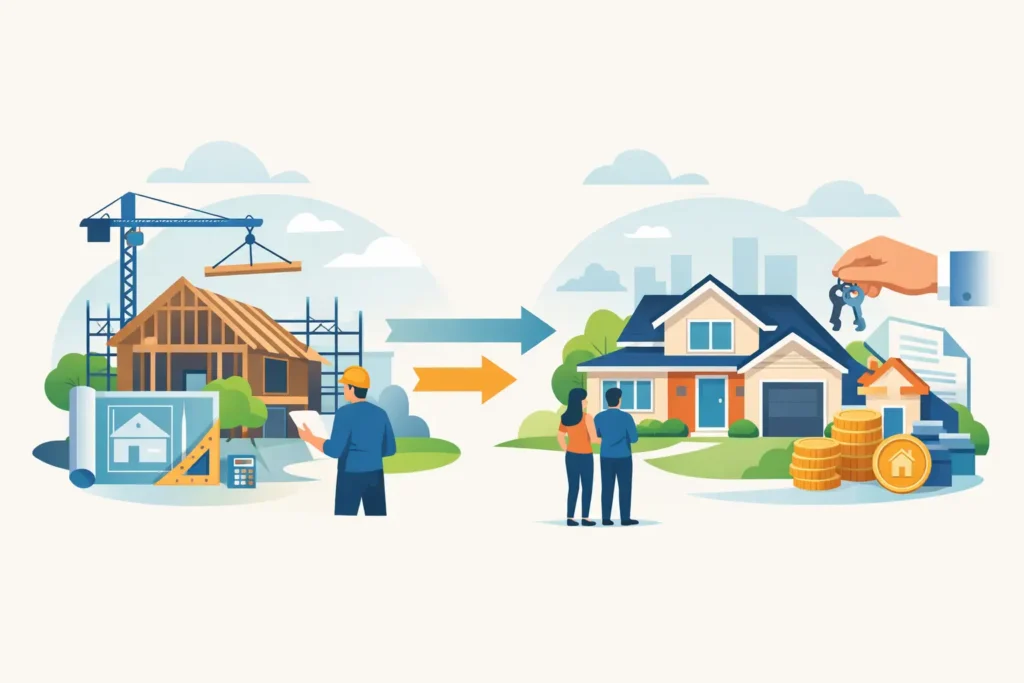

If you have already bought land, hired a builder, and sketched out your budget, the construction to permanent loan process is where excitement meets paperwork. This is also the point where many borrowers get burned by vague answers, shifting terms, or a broker who is responsive at pre-approval and missing when builder deadlines hit. A good broker should act like an ally here – translating the math, coordinating the moving parts, and helping you avoid expensive surprises before the first draw goes out.
By Duane Buziak, NMLS #1110647 – $95.6M in solo production
Table of Contents
- What the construction to permanent loan process actually is
- How the timeline usually works
- A worked dollar example with real math
- Where approvals get stuck
- Construction-to-perm vs two-close financing
- What to prepare before you apply
- FAQ
What the construction to permanent loan process actually is
A construction-to-permanent loan combines the short-term financing used during the build with the long-term mortgage that replaces it after the home is complete. Instead of closing once for construction and then again for the final mortgage, you typically close one time up front, then the loan converts to permanent financing when the home meets completion requirements.
That sounds simpler, and often it is. But simpler does not mean loose. The broker, borrower, builder, appraiser, title company, and underwriter all need to line up around the same plans, specs, budget, timeline, and contingency structure. If one piece is weak – builder approval, land value, reserves, or appraisal support – the file can stall.
The biggest practical difference is this: approval is based not only on you as the borrower, but also on the project itself. Your income, credit, assets, and debt matter, but the plans, contract, build cost, and builder credentials matter too.
How the construction to permanent loan process usually works
The front end looks familiar. You start with a pre-approval or soft pull mortgage review so the broker can evaluate credit, income, assets, and payment comfort before you spend money on plans or deposits. At TheMortgageAlly, that conversation often starts with a NoTouch Credit Pull, which is a soft pull pre-approval, soft credit review, no hard inquiry mortgage review, and credit-safe pre-approval all rolled into an early planning step. It helps you pressure-test the deal without creating a hard inquiry just to ask smart questions.
Once the personal side looks workable, the file shifts into project review. That usually includes the executed builder contract, architectural plans, specifications, line-item cost breakdown, proposed timeline, and documentation on the lot. If you already own the lot, that equity may help with down payment structure. If you are buying the lot as part of the project, that cost gets folded into the total transaction analysis.
Then comes the as-completed appraisal. The appraiser does not value a partially built home based on hope. The appraiser reviews the plans, specs, and comparable sales to estimate what the completed property should be worth when finished. That future value is central to the approval.
After underwriting signs off, you close once. Funds are not handed over in one lump sum to the builder. They are released in draws as work is completed. During construction, you may make interest-only payments based on the amount disbursed, depending on program structure. When the home is finished and final inspections are cleared, the loan modifies into the permanent mortgage phase.
A worked dollar example with real math
Here is a clean example of how the numbers can work.
You own a lot worth $85,000 free and clear. Your builder contract is $415,000. Soft costs – permits, plans, contingency, interest reserve, and closing-related project costs – total $30,000. Your total project cost is $530,000.
The completed home appraises at $560,000. If the program allows 90% loan-to-value on the lesser of cost or appraised value, the maximum base loan is 90% of $530,000, which equals $477,000.
Now subtract that from total project cost. $530,000 minus $477,000 equals $53,000 required equity or cash contribution.
Because you already own the lot worth $85,000, that lot equity more than covers the $53,000 requirement. In this scenario, you may not need to bring a down payment for the construction portion beyond closing-related funds, reserves, or items not eligible for financing. You would have $32,000 in remaining equity above the minimum requirement.
That is why real math matters. Two borrowers with the same income can have very different outcomes depending on whether they own the lot, how much contingency is required, and whether the appraisal comes in above or below total cost.
Where the construction to permanent loan process gets stuck
Most problems show up long before the slab is poured. The first issue is incomplete builder documentation. If the builder is slow to provide licensing, insurance, references, plans, or a detailed budget, underwriting cannot just guess. Borrowers often think the delay is financing, when the real problem is a builder package that is too thin.
The second issue is a budget that looks clean on paper but ignores real-world overages. Construction projects rarely fail because the original estimate was too detailed. They fail because the estimate was too optimistic. Material changes, site work surprises, and utility costs can hit fast. A realistic contingency reserve is not pessimism – it is protection.
The third issue is appraisal mismatch. If your plans call for a custom build in an area with limited comparable sales, the as-completed value may not support the full cost. That does not always kill the deal, but it can increase cash needed or force design changes.
The fourth issue is communication. Construction files have more handoffs than a standard purchase. If your broker is hard to reach, or if nobody is clearly managing builder questions, draw timing, and underwriting conditions, small issues turn into missed deadlines.
Construction-to-perm vs two-close financing
For many borrowers, one-close financing is the cleaner path because it reduces duplicate closing costs and lowers the risk of having to re-qualify for a separate end loan later. But it is not always the automatic winner.
A two-close structure can make sense if you want maximum flexibility to shop the final mortgage later, or if your project has features that fit better with a stand-alone construction phase first. The trade-off is more complexity and usually more total transaction cost.
| Dimension | Construction-to-Permanent | Two-Close Construction |
|---|---|---|
| Number of closings | One closing up front | One construction closing and one end-loan closing |
| Re-qualification risk | Usually lower if conversion terms are built in | Higher because the permanent loan is a second approval event |
| Closing costs | Often lower overall | Often higher because there are two transactions |
| Flexibility after build | Less room to change course late | More flexibility to choose final financing at completion |
| Best fit | Borrowers who want predictability and fewer moving parts | Borrowers who value optionality and can handle added complexity |
If you are comparing broker options against larger retail brands like Rocket Mortgage or Movement Mortgage, the right question is not just who advertises construction financing. Ask who will walk through plans, builder approval, draw structure, and contingency line by line with you.
What to prepare before you apply
The strongest construction files start before the formal application. You want your income documents current, your asset paper trail clean, and your land ownership or purchase terms documented. You also want a builder who can produce a real package, not a one-page estimate and a handshake.
It also helps to sort out your planning questions early. Are you using land equity? Do you need interest reserves built into the loan? Is your builder approved? Are there HOA restrictions? What will happen if the build runs 60 days late? These are not side questions. They affect approval, cash to close, and stress level.
This is where a NoTouch Credit Pull can be useful a second time in the conversation. A no credit hit mortgage review lets you explore feasibility, compare options across 500+ wholesale channels, and figure out whether the project is financeable before a hard inquiry is even necessary. For borrowers who have been burned by assembly-line mortgage experiences, that breathing room matters.
Government-backed and conventional options each come with different rules on occupancy, documentation, and builder standards. If you want to review broader consumer guidance on mortgage qualification and homeownership, the Consumer Financial Protection Bureau and the U.S. Department of Housing and Urban Development both offer useful baseline information.
FAQ
Is the construction to permanent loan process harder than a regular mortgage?
Usually yes. You are qualifying both the borrower and the project, so there are more documents, more third parties, and more chances for delays.
Do I need a down payment if I already own the lot?
Not always. Lot equity can often count toward the required investment, but the exact amount depends on loan-to-value limits, appraised value, and total project cost.
How are payments handled during construction?
Many programs use interest-only payments on funds that have actually been disbursed. The exact payment structure depends on the program and loan setup.
What happens if the appraisal comes in low?
You may need to bring in more cash, reduce project scope, renegotiate builder costs, or restructure the transaction. A low appraisal is not always fatal, but it changes the math.
Can I choose my own builder?
Often yes, but the builder usually must meet approval standards for licensing, insurance, experience, and documentation.
How long does the process take?
Longer than a standard purchase. The borrower review may move quickly, but builder approval, appraisal, plan review, and underwriting can add meaningful time.
Is one-close always better than two-close?
No. One-close usually offers more predictability. Two-close may offer more flexibility later. The better option depends on your project, cash position, and risk tolerance.
When should I start the conversation with a broker?
Before you finalize the builder contract if possible. That gives you time for a soft pull pre-approval, no hard inquiry mortgage review, and credit-safe pre-approval discussion before money gets committed in the wrong place.
If you are building a home, you do not need a rate quote machine. You need someone who will slow the process down enough to get the numbers right, then keep it moving when timelines tighten. For borrowers in Virginia, Florida, Tennessee, Georgia, and Washington, DC, that is where a relationship-driven broker can save more than frustration.
Legal disclaimer: This article is for general educational purposes only and is not a commitment to lend. Mortgage financing is subject to borrower qualification, property approval, program guidelines, and state licensing requirements. Coast2Coast Mortgage LLC, NMLS #376205, is licensed in VA, FL, TN, GA, and DC only.
Duane Buziak, NMLS #1110647 Coast2Coast Mortgage LLC, NMLS #376205 Scotsman Guide Top Originator #114 in 2025 VA Broker of the Year 2024-2025 $95.6M solo production Serving licensed clients in VA, FL, TN, GA, and DC